

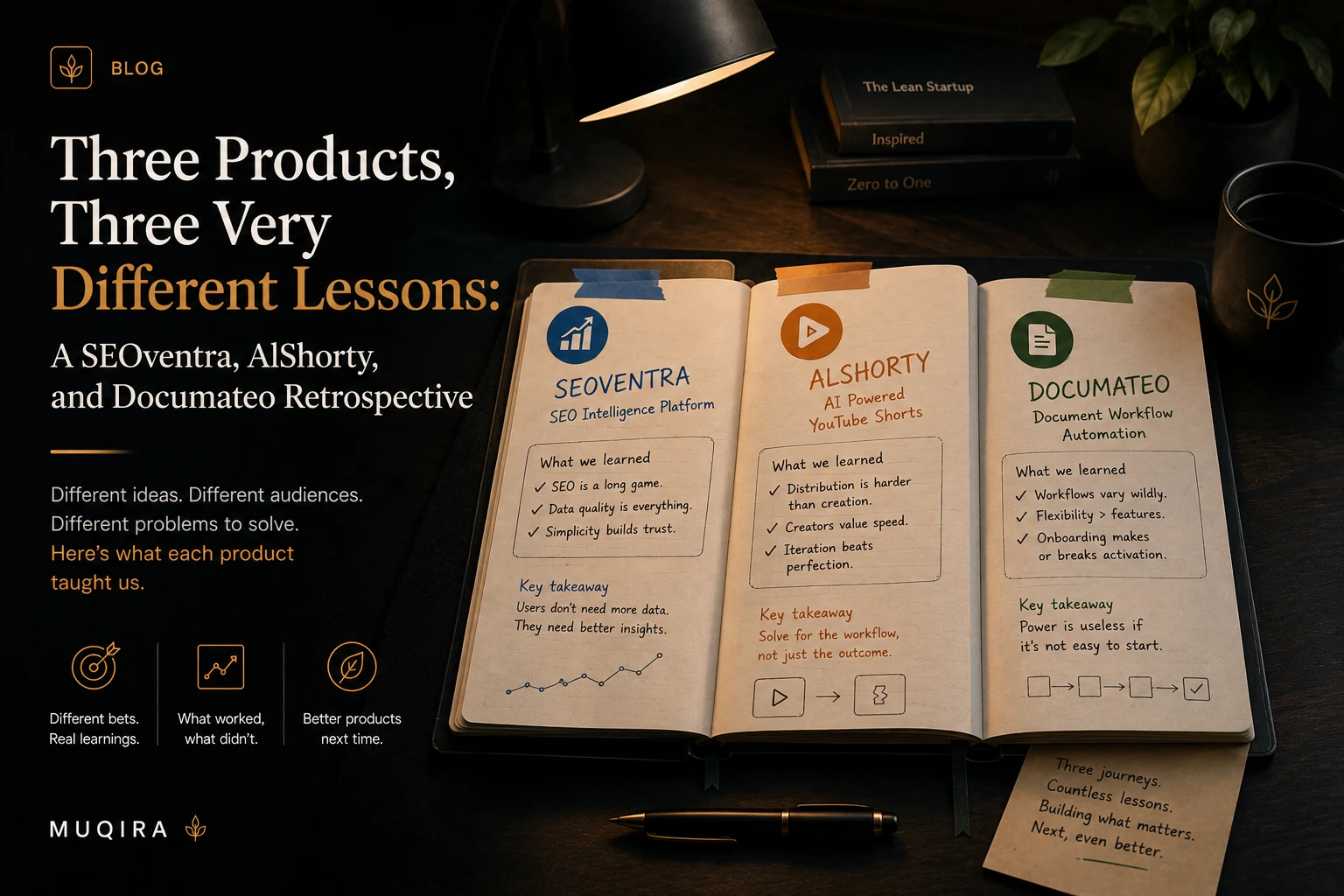
Three products, one small team
We've written separately about building SEOventra, AlShorty, and Documateo. What we haven't done until now is put the three side by side and ask what they actually have in common.
What SEOventra taught us
SEOventra's hardest problem was never the technology. The hard problem was distribution. What worked was radical narrowness: a product that did three things, aimed at people who had a single Monday-morning question.
What AlShorty taught us
AlShorty's hardest problem was infrastructure: an 11pm outage from 300 simultaneous clicks taught us, painfully, that a URL shortener isn't a database lookup, it's a piece of infrastructure other people's businesses quietly depend on staying up forever.
“SEOventra needed us to find the right people. AlShorty needed us to never let the right people down once they'd found us. Those are almost opposite disciplines.”
What Documateo taught us
Documateo's hardest problem was the browser itself. Choosing to process every PDF entirely client-side meant fighting browser memory limits, WebAssembly load times, and the strange UX problem of showing honest progress for invisible work.
The pattern underneath all three
Despite three completely different hardest-problems, the discipline that got each product from idea to something real looked identical: ship something embarrassingly small, watch what real people actually do, be willing to discard your own roadmap.
What this means for what's next
We're applying all of this directly to Muqira AI and Muqira Flow. Muqira AI's hardest problem looks more like SEOventra's. Flow's hardest problem looks more like AlShorty's. We've solved versions of both before, and that's a better position to build from than starting blind.
Enjoyed this article?
Get new articles, product updates and insights from Muqira in your inbox.
Found this useful? Share it.